The Magazine is shutting down

Sad news.

The Magazine was an interesting publication. A paid-for collection of long-form articles, with a simple content-first idea: putting the writers first, so that they could publish great content.

I'm guessing that you probably haven't heard of it. And I'm guessing thats a bit part of the reason why it has shut down.

Jim Dalrymple (publisher of The Loop website, and its sister Apple Newsstand publication The Loop Magazine) had this to say;

I understand the issues of being an independent publisher on Apple’s Newsstand—it’s not fun. Apple should just admit that they don’t give a shit about digital magazines and be done with it.

Maybe its just that the idea of tablet publishing is going through a trough of disillusionment. But I imagine that in a parallel world, where it got picked up by someone with the money to promote it to a wider audience, it would still be being read by the kind of people who subscribe to Wired but can't be bothered to download the enormous and frankly pointlessly "multimedia" iPad application, or the kind of people who pick up copies of gadget magazines, flip through the pages and wish that there was something stimulating amongst the endless stream of smartphone and hifi reviews.

I like to think that, back in this world, there is still a space for something like The Magazine – that the same idea, perhaps slightly tweaked, can be a long-term commercial success. At least, I hope so.

Don't underestimate the power of convenience

A couple of years ago, we got a new 1 car. Being a gadget nerd, I was very keen to make sure that it had a bluetooth stereo that could connect to my phone (although not quite clever enough to make sure that it would play music from my phone – not just connect to make hands-free calls.)

But even as a gadget nerd, I thought that the "keyless" feature – where you only have to have the key with you, then press a button to unlock the doors/turn a knob to start the engine – was pointless. How lazy would you have to be to not be bothered to get a key out of your pocket? And isn't it just asking for trouble – when your key runs out of battery and leaves you unable to get into or start your car? Or if it gets wet or something and the electronics break?

I was so wrong – because I was looking at it from the perspective of someone completely used to the way that I had worked with my previous cars. I had never even thought about situations like;

  • Carrying a load of bags to the car from the supermarket and wanting to open the boot,
  • The car knowing if my wife's keys were inside when I try to lock the door,
  • Having a baby in my arms who is fighting tooth and nail to get out of my arms, while preparing myself to wrestle her into her car seat,
  • Coming back from a service station with a cup of coffee in one hand and some food in the other,

…and probably plenty of other situations where I have breathed a quiet sigh of relief that I just have to press a button – or even ask my 5 year old to press the button – to lock or unlock the car.

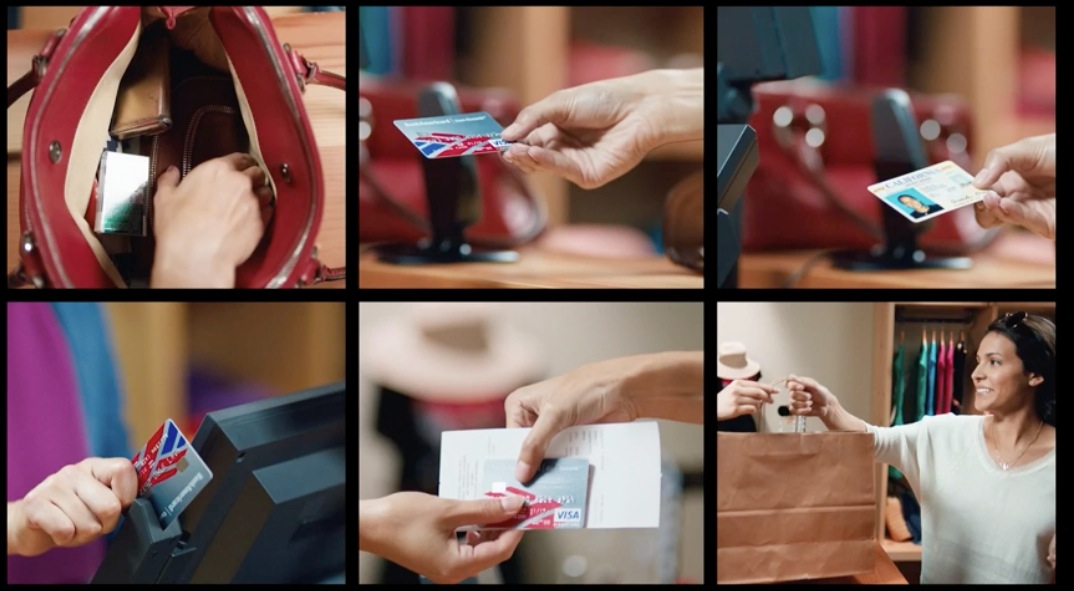
This is the experience that I keep coming back to when I'm thinking about things like NFC payments and "smart watches". Sure, I don't need contactless payments as a feature on the cards in my wallet – but when I need to make a payment quickly when I've got my hands full (which is much more likely to happen if you have small children than if you don't) then the speed of contactless is a definite plus. And although its easy to mock Apple's video of "how payments work today" as a woman fumbles with the stack of cards in her wallet, it is without a doubt far easier to take out a phone from your pocket and present it to a payment terminal with one hand than it is to take out your wallet, remove a credit card and put it back in again.

As for online payments and the "verified by VISA" system that makes me have to enter my card details repeatedly, try to remember which unique, ultra-secure password is attached to which card – I get a sinking feeling every time the logo pops up on my screen.

Sure, I can get by quite happily taking my phone out of my pocket when it buzzes to tell me there is something I have already said I want to be alerted to. But for those occasions where I'm in a meeting at work, or having a conversation with someone, I would much rather be able to glance at my wrist to see whether I need to even think about it right now, or if I can happily ignore it for the next hour or so.

I think the way to think about systems that promise to add a level of ostensibly pointless 'convenience', the question to ask isn't "do I need this feature"? Its "if I had this feature already, would I choose to switch to what I'm currently doing"?

For example, if I was using QR codes, I think I would quite happily switch to typing in a short URL. If I was paying for everything with my phone (one-handed), I can't imagine switching to a world where I have a collection of cards in my wallet.

For all the talk about retailer security, data protection and so on (which is important in making the system available - not whether people will use it), I think thats the issue that is going to determine whether systems like Apple Pay will succeed or fail. And while the Apple Watch is being pitched as a fashion item rather than a functional phone accessory (which similarly is important in making the convenience available), I think thats the issue that is going to determine whether those early adopters find it to be something that offers genuinely useful functionality, rather than simply being a 21st century take on finely engineered jewellery.

  1. By "new", I mean "used".

Accuracy vs Precision

Today's XKCD;

I'd be inclined to take this a step further; when you say "people are stupid compared to your expectations", what you are really saying is that my expectations of how smart people are is constantly and consistently wrong, yet I am unwilling to change my expectation to accomodate this information.

One of the things that stuck with me from my degree 1 is the idea of "Accuracy" vs "Precision."

Precision is essentially about consistency – a repeated measurement will give very similar values. Accuracy is about a measurement being close to a "true" value. So, a measurement using an incorrectly calibrated set of weighing scales can be very precise (always reporting the same weight), but not very accurate. Or reporting a figure to a large number of decimal places can be a very precise measurement – but that doesn't mean that it is an accurate one.

So, the "people are stupid" statement could be taken as saying that your views are not accurate, you know that they are not accurate, you know how you could change your views – but you refuse to. Perhaps to maintain your belief in your own level of relative 'smartness'.

Which, I guess, is pretty stupid…


It also reminds me of my favourite George Carlin quote – Think about how stupid the average person is. Then realise that half of the population is more stupid than that. 2

  1. I studied Chemisty with Environmental Chemistry. On one hand, I probably should have switched to a topic I found more interesting when I realised that I wasn't going to maintain a keen interest for 3 years. On the other hand, I'm not sure I would have necessarily made a better choice.

  2. Of course, if you interpret "average" to mean "mean", then this assumes that stupidity/smartness is normally distributed, and the mean and median are the same – which is not necessarily true.

Teaching kids to code

I've noticed a lot of talk about "learning to code" over the last couple of years — both from the likes of Codecademy promoting services, and from people I know who are interested in the idea of "learning to code."

Now, there is a whole topic around what "learning to code" means, who should really be doing it and at what level, but as someone who has taught themselves languages like PHP, Javascript, Ruby, Objective C, VBA and a few others, my main interest is how to get my kids interested at an early age. I don't know if its something that they will be interested in, but I do want to make sure that if they are, then I'm making it as easy for them as possible.

I didn't think that it was something that would be happening any time soon — my eldest is about to turn 5, and his maths knowledge is still at the "adding and taking away" stage. But I was surprised to discover that apparently as a part of the National Curriculum, next year he will be learning about "code" at school. Which means, I suppose, my "job" isn't so much about giving him a head start as giving him support.

Which means that a couple of apps that I recently discovered should be worth sharing with anyone with kids of a similar age.

The first one is Daisy the Dinosaur. Its very simple, and basically consists of writing instructions to get a cartoony dinosaur to perform certain tasks. For example, to get her to reach a star, you give the instructions to move forwards and then jump. Its a simple drag-and-drop interface to move "commands" into the "program", and (I think) quickly gets across the idea of chaining commands and loops.

Its very basic, but enough to give you an idea of whether this is going to be interesting or not. Once you've cleared the (low) bar that it offers, had a play around with the "free" mode and got to the point where you want to do something beyond the ability of poor Daisy, then take a look at Hopscotch from the same developers. This is pretty similar at first glance, but also lets you create your own "rules" from a set of different commands. Its got another level of complexity, and its probably worth spending a bit of time with it yourself before introducing it to your kid (and playing along with them.) On one hand, this seems like it could be a bit intimidating, but on the other, the language it uses is "Turing complete" — which means that the possibilities of what can be done with it are limited by what can be done with computers in general, rather than specific limitations of the application. So if you consider that, its actually a very impressive application.

(And if you're in the position now where you might find your 5 year old teaching you things you didn't know about coding, maybe you should just quietly download them for yourself.)

One Note for Mac

A couple of months ago, I came across and wrote about Microsoft's OneNote application;

I was digging around the applications that came with a recent work upgrade to Office 2013, and came across OneNote, which I thought might have been interesting. Until I noticed;

OneNote is available for Windows, iOS, Android, Windows Phone, and Symbian.

So, an application for "free-form information gathering and multi-user collaboration" (interesting) that I can't use on my 'main' computer (effectively useless, unless I want to use it through a browser.) Lets suppose that Microsoft have a killer app in the pipeline – what are the chances that they will make a Mac version out of the gate? Seems unlikely.

Well, since then Microsoft released OneNote for Mac.

It seemed like fortuitous timing – it happened that on the same day, my work email moved from Lotus Notes to Outlook, so I'm hoping that a few of my daily pain points around email will disappear (and the inevitable new pain points won't be as bad…) And, having also recently upgraded to Office 2013 a few weeks before, I've got plenty of new tools to play with. So, I've installed OneNote on my own laptop, my phone, and my iPad. (Naturally, I've also installed the new Office apps too – although I haven't yet had a reason to have a proper play and figure out if a 365 subscription is worth my while.)

What am I going to do with it though? Currently, my 'notes' system revolves around a combination of nvALT (Mac), Notepad++ (PC), Nebulous Notes (iPhone/iPad) and a Dropbox folder to tie it all together. The only catch is that its very much text-based – so the idea of a system for 'richer' notes is appealing. (For example, taking notes during a meeting, where I can easily separate out action points from points I want to reference etc.)

The first thing that appeals about OneNote is the free-form-ness of it. More than any other application that comes to mind, it resembles the way I like to use a paper notepad – but without the limitations of space that a paper notepad clearly has.

The second thing that appeals is the idea of collaborative working – I'm a fan of the idea of personal information management, through notes, wikis etc. My biggest frustration with Office documents is the 'read only' message when you ry to open a document that someone else is using. The idea of being able to store my own notes on, say, ways to use a piece of software we use at work that others can also add to is very interesting to me.

So, first impressions – now that its cross-platform, it has become a lot more useful. From a first glance, it looks interesting. (And seeing the icon on the IFTTT page is very encouraging.) So, I'm going to be looking out for ways it might be helpful – whether that means taking a laptop into meetings/presentations, or using a phone/iPad for note taking and then the desktop version for organising/formatting etc. I'm not sure just yet. But worth a whirl...

…except – irony of ironies – my PC version (that is, the non-free, paid-for-by-my-employer version that is part of Microsoft Office, that Outlook is peppered with links to) doesn't work. Or at least, it doesn't work with OneDrive (presumably disabled to keep 'work stuff' under work's control) or Sharepoint (not yet activated while the IT guys deal with the rest of the Outlook/Exchange/Sharepoint transition – I'm hoping…).

So now, in a complete reversal of my previous position, I'm able to make full use of it in a 'personal' capacity (on my own computer, my own phone, and my own tablet), but not in a 'professional' capacity on my work hardware. For a piece of software which, as far as I can see, would be much more valuable to me in a work context than a personal one.

Microsoft's troubles are starting to become a little clearer to me…
Microsoft In Talks To Acquire Mobile App Development Startup Xamarin

Sources: Microsoft In Talks To Acquire Mobile App Development Startup Xamarin | CRN

Microsoft is in the final stages of negotiations that could lead to either an acquisition or major investment in Xamarin, a mobile startup whose tools make it possible to code iOS and Android apps using Microsoft development tools, sources with knowledge of the discussions told CRN recently.

When the iPhone SDK was first released, the fact that you had to use a Mac to develop for the iPhone was seen by many as a significant disadvantage – even more so once Android started gathering steam.

I don't know how much of an issue it is today, but I would guess that for developers, it is now seen more as a selling point for OSX than a disincentive to work on iOS.

(via Benedict Evans' newsletter.)

Ctrl-Alt-Del on the Mac

On a PC, Crt-Alt-Delete (A.K.A. the Three Finger Salute) is a keyboard shortcut that just about everybody knows. If you need to kill something that isn't running, then thats usually the solution.

The Mac has an equivalent - Command-Option-Escape, which brings up a window to let you force-quit an application.

I've been using a Mac for about four and a half years. But I have to Google for that key combination every time I have to use it, because I've only had to use it about four times.

All-at-once-ness

Ours is a brand-new world of all-at-once-ness. "Time" has ceased, "space" has vanished. We now live in a global village...a simultaneous happening. We are back in acoustic space. We have begun again to structure the primordial feeling, the tribal emotions from which a few centuries of literacy divorced us.

Marshall McLuhan, "The Medium is the Massage", 1967, p. 63

Will "Print" outlive "desktop"?

"Print will be around longer than the desktop," New York Times Publisher Arthur Sulzberger Jr. told a group of media professionals Thursday morning.

Interesting point of view — I don't think anyone is really arguing against the idea that "mobile" (including tablets) is the future of "computers." (A report from Enders Analysis today talks about mobile devices accounting for 50% of time spent online in the UK, and tablet shipments overtaking PC sales.) The "PC" is clearly in decline as mobile is growing.

But the same story has been accepted to be true of print for a good few years now — pring has been in decline while "digital" was a growth story. So its a thought-provoking question - which one will last longer — "old" physical print, or "old" digital?

To be honest, I wouldn't like to bet against the long-term future of print. But then again, is its future going to be just as much of a "speciality" as a personal computer?

The new way to do subtraction

Apparently an image is doing the rounds on Facebook, depicting the crazy way schools today are teaching maths.

I haven't seen it – partly because I haven't been spending much time on Facbeook recently (especially over the last few weeks), and partly because I don't think its the kind of thing my friends would be posting 1. But its one of those things where it isn't until you stop and think about it that you realise that the way 'we' were taught how to do subtraction is actually a) pretty complicated, b) pretty impossible in most day-to-day situations, and c) not the way that you actually tend to do subtraction in your head.

Subtraction is one of those things that I think I assumed we had cracked hundreds of years ago. Turns out we hadn't quite nailed it yet.

I do wonder what sort of things my kids are going to aske me for homework help with in a few years that is going to baffle and confuse me.

[EDIT - updated with working link to the original story...]

  1. At least, not the ones that Facebook predicts that I'm going to find interesting.

"…on every desk, and in every home"

Microsoft's original mission statement;

A computer on every desk and in every home, running Microsoft software.

Something I talked about recently;

Consumers have made it clear over the last decade or so that they want laptops that they can use anywhere, rather than desktops that are tied to a desk. And I don't think on the whole that they are particularly interested in using their laptops at their desks either.

The 'Microsoft software' part is interesting to think about. If it used to be Office that was what people wanted to run, then Windows what what they needed to run.

Today, Office is the only Microsoft software running in my house – not because I want it 1, but because if I want to work at home without lugging my office latop back with me, I need it.

But what else is there that Microsoft make that I would want to install on my own Mac? I was digging around the applications that came with a recent work upgrade to Office 2013, and came across OneNote, which I thought might have been interesting. Until I noticed;

OneNote is available for Windows, iOS, Android, Windows Phone, and Symbian.

So, an application for "free-form information gathering and multi-user collaboration" (interesting) that I can't use on my 'main' computer (effectively useless, unless I want to use it through a browser.)

Lets suppose that Microsoft have a killer app in the pipeline – what are the chances that they will make a Mac version out of the gate? Seems unlikely.

What are the chances of a genuine Excel alternative appearing any time soon? For me – pretty slim. For me, Excel is the swiss army knife of 'data' tools – I use it as a calculator, a spreadsheet, an organiser, a chart builder, for natural language processing, statistical analysis… Pretty much anything involving 'data', I'll do my first pass in Excel. For anything boring, I would rather delegate it to an Excel macro than to someone else to deal with manually. (Often, its quicker to tell a computer what to do than to explain the problem to a human.)

But lets face it – thats not how most people use a computer. Most people either have no interest in complex .XLSM workbooks, or if they do then they are using them rather than building them. And if they aren't building them, then they are probably better off using something other than Excel for the job (something Benedict Evans has posted some thoughts about.)


So. Back to Microsoft.

…on every desk

Somewhere I don't think most people want a computer any more,

…in every home

Somewhere I don't think most people need Microsoft software any more.

I can't help but think that in 5 years or so, 'everybody' will be criticising the new Microsoft CEO for not doing the things that, with hindsight, he "obviously" should be doing right now.

But right now, for the record, I just can't see what it is that he should be doing. Other than maybe figuring out a better way for Microsoft to say what they want to be doing.

  1. although my relationship with Excel is kind of love/hate…

"Your an idiot"

"Your an idiot" – apparently the 'most internet sentence.'

Its a lovely analysis, and 1 I thought I'd have a look at just how 'internet' the phrase turned out to be.

The most retweeted "your an idiot" tweet is a reasonably standard 'step four' response from Frankie Boyle;

614 retweets at the time of writing

I particularly liked the most retweeted 'step three' (ie. non-referential) tweet;

To quote from Wikipedia;

At the bottom of the table, Queens Park Rangers were relegated after a thoroughly dismal campaign in which they recorded the worst start in Premier League history, with not even Harry Redknapp's appointment as manager and a substantial investment in players during the January transfer window significantly improving their fortunes.

The most authoritative news story (according to Sysomos' measure of 'authority') – a story about another 'step four' usage - ABC News - Samuel L. Jackson schools the president;

“I’ll be reading scripts and the screenwriter mistakes ‘your’ for ‘you’re.’ On Twitter someone will write, ‘Your an idiot,’ and I’ll go, ‘No, you’re an idiot,’ and all my Twitterphiles will go, ‘Hey, Sam Jackson, he’s the grammar police,” Jackson said. “Somebody needs to be,” he added. “I mean, we have newscasters who don’t even know how to conjugate verbs, something Walter Cronkite and Edward R. Murrow never had problems with. How the f> *> did we become a society where mediocrity is acceptable?”

The 'most authoritative' tweet;

Again, 'step four' is a popular one – especially when from a celebrity. (Rob Lowe has 815,084 followers.)

Fox News – joint biggest "your an idiot" authority…

Fox News – joint biggest "your an idiot" authority…

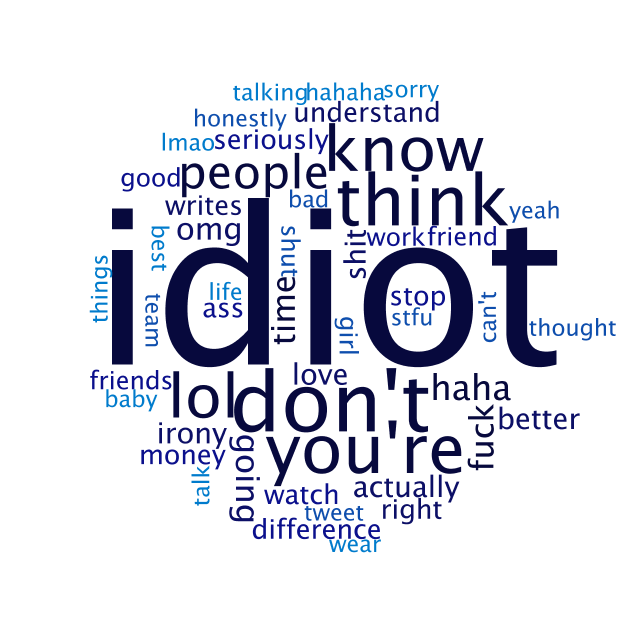
A wordcloud of "your an idiot" Twitter mentions isnt particularly enlightening (although the word 'irony' is a nice indication of 'stage 4' popularity…)

Twitter wordcloud

Twitter wordcloud

But looking at volumes over time, perhaps its actually a bit of a 2013 thing – volumes seem to have been steadily decreasing. (The rise of mobile and autocorrect, perhaps?) The 600 tweets a day estimate in the original article seems to be a little high – although its definitely down from about 850 a year ago.

Tweet volume

Tweet volume

Perhaps unsurprisingly, its less of a big deal in the blogosphere;

Blog mentions

Blog mentions

…and, although nowhere near as big as Twitter, still fairly popular on forums.

Forum mentions

Forum mentions

  1. before things went a bit crazy over the last couple of weeks

Tedx - David Puttnam: Does the media have a "duty of care"?

Vaguely related to my everyone is wrong about everything post recently - a Tedx talk that (kind of) addresses the issue of why people are so misinformed, and what might be done about it – Does the media have a duty of care?.

The summary;

In this thoughtful talk, David Puttnam asks a big question about the media: Does it have a moral imperative to create informed citizens, to support democracy? His solution for ensuring media responsibility is bold, and you might not agree. But it's certainly a question worth asking ... (Filmed at TEDxHousesofParliament.)

Framed in the context of the Paisley snail and laws around duty of care, its ultimately a discussion of the role of the media in building an informed democracy.

Personally, I tend to share Kevin Kelly's optimistic view 1 that, while technology creates new problems, the benefits of the ones that we adopt outweigh the problems that they create. Which means that I do have a belief that things will get better.

But when it comes to the question of how media/communications will lead to a more informed electorate, able to make better decisions about what to do with their power, and a shift of power to those people (as opposed to the politicians, media, corporations etc.)

Its not that I don't see it as a goal. I just don't see a likely path towards it.

  1. Better expressed in his book "What Technology Wants", but I can't find a suitable link.

Twitter, TV and the One Direction effect

Around this time last year, we did a fun little project around pancake-related tweets on pancake day. The biggest driver of tweets over time was a hashtag game, around #replacebandnameswithhashtags.

But the biggest driver of activity was this relatively innocuous tweet;

The impact was pretty clear; a massive spike in activity as it was retweeted and replied to;

(The secondary spike a short while later was the result of his girlfriend also tweeting about pancakes.)

I've been doing a few projects around tracking Twitter mentions and conversations around various topics, and it has become something of a joke – if there is a massive, inexplicable spike in tweets, the first thing to check is whether one of One Direction happened to say something related. And I'd say that as often as not, if no other explanation is apparent, then that is what it turns out to be. We call it the One Direction effect.

Another topic I've been watching (along with many others) is the interaction between Twitter and television. Just over a year ago, a Twitter spokesman said that 40% of tweets were about television during peak TV hours – a huge volume.

What would happen if the two collided? This week, we found out, thanks to SecondSync's analysis. They tweeted;

So, how much of a difference did it make?

This much.

To put that into context, in last week's round up they also mentioned the Graham Norton show;

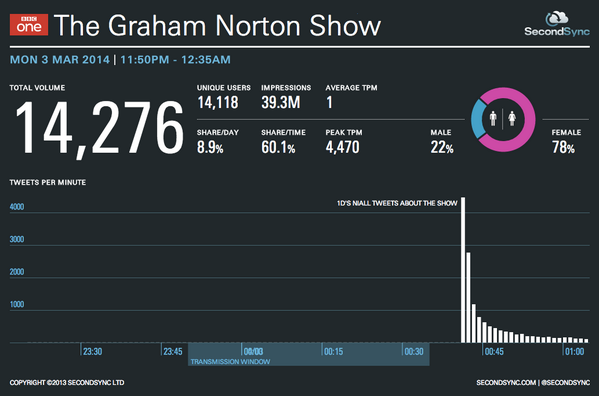
The top show on Friday night’s leaderboard was the final episode of the current series of The Graham Norton Show, which attracted 16,551 tweets, the most it has recorded for an episode in 2014. The most popular guest on the show was Breaking Bad’s Aaron Paul, mentioned in over 5,600 tweets, while a peak of 506 TPM was reached in reaction to Ellie Goulding’s live performance. Overall, 75,646 tweets have been recorded for the eight episodes broadcast in this series.

So, the most tweeted about programme on a Friday night generated sixteen thousand tweets. But a single tweet from a One Directioner alone (during a repeat – not the live broadcast) generated nearly fourteen thousand – in a very intense burst.

This is their analysis of twitter volume over time – for a particularly popular (in Twitter-terms) episode of a popular show, in its original broadcast.

Note the difference in scales to the chart above.

Television gets a lot of attention when it comes to discussion of Twitter and their share price/market value.

Funny how One Direction don't get as much attention. I wonder what would happen if they started posting exclusively to Facebook?

Everyone is wrong about everything

A study from Ipsos MORI carried out last year took a look at how public perceptions and actual facts differ wildly. For example;

  • We think that 15% of girls under 16 get pregnant every year - official figures suggest it is around 0.6%
  • 29% of people think we spend more on Job Seekers Allowance than pensions – actually, we spend £74.2 billion on pensions and £4.9 billion on JSA
  • The public (on average) think that £24 of every £100 spent on benefits is claimed fraudulently, when official estimates are £0.70
  • 26% think foreign aid is one of the top 203 items government spends money on, when it actually makes up 1.1% of expenditure (£7.9bn.) More say this is the top item of expenditure than pensions.

Somewhat depressing, when you consider that these are the people who elect the politicians they think will address the issues they feel are most important.

Data tables (albeit in a horribly formatted PDF) are also available for download.